
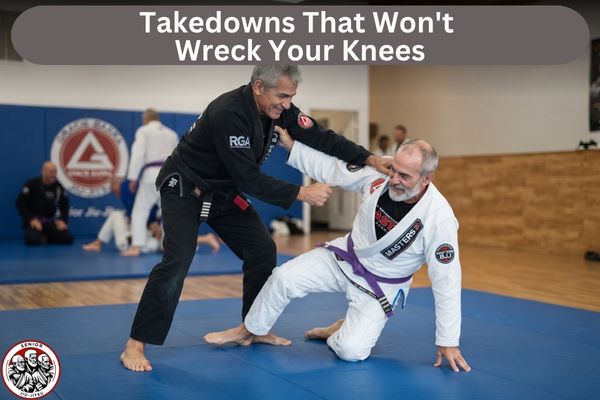
Most takedown drilling in a jiu jitsu class is built for a twenty-five-year-old body. The instructor shows a hip throw that asks for a deep bend at the knees, a sharp rotation through the lower back, and a burst of speed to get under the opponent’s center before they can sprawl. For a younger student, that sequence is just mechanics. For a student over fifty, it’s a list of ways to get hurt.
This doesn’t mean the standing game is off the table once you pass fifty. It means the standing game needs to be rebuilt around different tools: timing, weight reading, and off balancing instead of speed, torque, and deep squats. The techniques below aren’t a watered down version of real takedowns. They’re a different approach to the same problem, one that depends on reading your opponent rather than outrunning them.
Why the standing game gets riskier as you age
Cartilage thins with age. Tendons and ligaments lose elasticity. The disks in your lower back carry less fluid than they did two decades ago, which means they absorb shock less well. None of this stops you from training standing exchanges, but it changes what a safe technique looks like.
A young body can recover from a bad landing or an awkward pivot because the tissue bounces back. An older body that takes the same impact is more likely to walk away with a strain that lingers for weeks, or a joint that swells every time the weather changes. The risk isn’t that you’ll get thrown harder than a younger student. It’s that the same throw costs you more to absorb, and takes longer to heal from if it goes wrong.
The fix isn’t to avoid takedowns. It’s to choose takedowns that don’t ask your joints to do the expensive part of the work.
The three joints that take the most damage in traditional takedowns
Three joints carry most of the load in classic throws, and all three are common trouble spots for older training partners.
- Knees. Deep bends under load, especially combined with rotation, are hard on the meniscus and the ligaments around the kneecap. A hip throw that asks you to drop your level fast and twist at the same time puts a lot of this strain on one knee at the bottom of the motion.
- Hips. Explosive rotation through the hip socket, the kind that generates the power in a classic throw, works the joint through a range it may not move through smoothly anymore, particularly if there’s any existing arthritis.
- Lower back. Bending forward at speed while loaded with another person’s weight is one of the most common ways lower back injuries happen on the mat, standing or on the ground.
Keeping these three joints in mind while you choose which takedowns to drill is the whole strategy. If a technique asks for a deep squat, a fast hip turn, and a forward bend under load, it’s probably not the right one to build your standing game around.
Reading grips and posture before you ever attempt a takedown
Before any takedown attempt, there’s a moment where the exchange is decided and almost nobody is watching for it: the grip fight and the posture that follows it.
Watch where your opponent’s weight sits. A partner leaning forward on their lead foot has already given up their base in one direction. A partner standing too square, with their feet even and their weight centered, has given you an easy direction to push or pull them off. Grips tell you the same story. A high collar grip that pulls their head down also pulls their hips up and back. A sleeve grip that’s pulled across their body turns their shoulders before their feet can follow.
None of this requires strength. It requires attention. Older students who stay competitive in standing exchanges usually aren’t the strongest people in the room. They’re the ones who notice the opening a half second before everyone else does, because they’ve stopped waiting for an opening to force itself.
The trip over the explosion: foot sweeps and ankle picks that don’t need speed
Foot sweeps and ankle picks belong at the center of a low impact standing game because they work on timing, not torque. You’re not trying to lift or launch your opponent. You’re removing the foot that’s holding them up at the exact moment their weight has already shifted onto it less than they think.
A minor outer reap, done correctly, doesn’t require you to drop your level or explode through your hips. You’re clearing a foot that’s already light, using your own foot as the tool and your opponent’s forward momentum as the force. The same is true of a basic ankle pick: you’re not pulling their leg out from under them with your arm strength, you’re timing the pick to a moment when their weight is already committed away from that foot.
These techniques ask your body for something very different than a hip throw does. Your knees stay at a workable bend instead of dropping deep. Your back stays relatively upright. The power in the technique comes from your opponent’s own weight moving in a direction, not from your hips generating force against gravity.
Using your opponent’s weight instead of your own power
This is the actual shift in strategy, and it’s worth saying plainly: a standing game built for an older body stops trying to out-power the opponent and starts redirecting them.
Every takedown, at its root, is about taking away someone’s base. The traditional way to do that is to out-muscle them: lift them, turn them, drive through them. The low impact way is to use the base they’ve already started to lose. When someone pushes into you, they’ve already loaded weight onto their lead leg. When they pull away, they’ve already loaded weight onto their back leg. A standing game built around control waits for that loading to happen and then removes the leg carrying it.
This takes longer to get good at than learning to muscle a throw, because it depends on reading rather than reacting. But it pays off in a way raw power never does: it works on bigger, stronger opponents just as well as smaller ones, because you’re never trying to match their strength in the first place.
Falling safely: controlling your own descent to the mat
A takedown that doesn’t hurt your opponent’s joints is only half the job if it wrecks yours on the way down with them.
Older students often get hurt not from the takedown itself but from the fall that follows it, because they’re used to the breakfalls they learned decades ago and haven’t adjusted them for a body with less shock absorption. A few adjustments matter here:
- Keep a hand or forearm ready to meet the mat before your hip does, so the impact spreads across a wider surface instead of landing on one joint.
- Avoid locking your arm straight when you post, since a straight arm transmits force directly into the wrist, elbow, and shoulder instead of absorbing it.
- Where possible, follow your opponent down rather than dropping onto them, controlling the speed of your own descent instead of letting momentum decide it for you.
A takedown you can’t follow safely to the mat isn’t a low impact technique, whatever it looks like standing up. Controlling your own fall is as much a part of the technique as the trip or the sweep that started it.
Building a standing game around control instead of athleticism
None of this requires giving up on takedowns as you get older. It requires choosing the ones that reward patience and timing over the ones that reward explosiveness and deep range of motion. Foot sweeps, ankle picks, and off balancing built around your opponent’s own weight let you stay active and effective in the standing exchange without asking your knees, hips, or lower back to do more than they can safely give.
The students who stay sharp standing up well into their fifties, sixties, and beyond usually aren’t the ones still chasing the explosive version of a technique they learned thirty years ago. They’re the ones who rebuilt their game around reading an opponent instead of outmuscling one.
Add one of these takedowns to your next class and ask your instructor to drill it slowly before testing it at speed.