
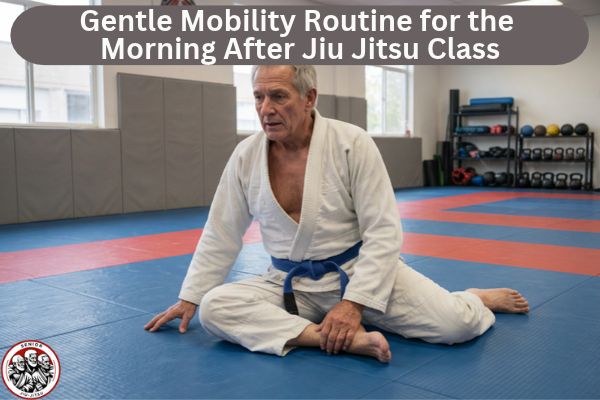
A mobility routine after jiu jitsu works best when it is slow, small and sequenced. Start in bed with ankle pumps, knee rocks and easy shoulder reaches. Then spend about ten minutes on the floor moving your neck, shoulders, spine, hips and knees through comfortable ranges. Stop at mild tension, never at sharp pain.
Why do you wake up so stiff after jiu jitsu class?
You wake up stiff because class loads your joints and muscles in positions you rarely use elsewhere, and they tighten while you sleep. Gripping, pulling, bridging, shrimping and holding a frame all work the same areas hard: neck, shoulders, hips, lower back and knees.
Muscle soreness often shows up a day or two after unfamiliar effort, so the morning after can feel worse than the evening of. Lying still for hours adds to it, because tissue that has been worked hard tends to feel stiffer after a long period without movement.
This routine comes from those sore mornings. It does not try to fix anything or stretch you into a new range. It gets blood moving and returns your joints to the movement they already have.
What should you check before you start moving?
Check where the discomfort sits and what kind it is before you move anything. A dull, general ache across several muscles is the usual after-class soreness. A sharp, localized, or pinching pain in one joint is different and calls for a lighter approach or a day of rest.
Run through this short list while you are still lying down:
- Location: Is the ache spread across a muscle group, or is it in one joint?
- Quality: Is it dull and achy, or sharp, hot or pinching?
- Sensation: Do you feel any numbness or tingling in a hand or foot?
- Memory: Do you recall a specific moment in class that felt wrong, such as a crank, a pop or a hard landing?
If it is a dull ache without numbness or a specific injury moment, go ahead. If any of the other signs are present, read the section on adjusting and stopping before you continue.
Keep the room warm enough that you are not tensing against the cold, and give yourself the full ten minutes without hurrying to the next thing.
How do you start the routine before you get out of bed?
Start with small movements while you are still lying down, because they wake up your joints before you put your weight on them. Spend about three minutes here, and keep every move at half the effort you think you can manage.
- Ankle pumps (30 seconds): Point and flex both feet slowly. This moves the lower legs and tells you quickly whether your knees feel stable.
- Knee rocks (45 seconds): With knees bent and feet flat, let both knees fall gently to one side and then the other. Keep your shoulders on the mattress and go only as far as feels easy.
- Single knee hugs (45 seconds): Draw one knee toward your chest with both hands, release, and switch. Stop short of any pinch in the front of the hip.
- Overhead reach (45 seconds): Slide both arms overhead along the bed, and let your ribs rise a little as you breathe in. Bring them back down slowly.
- Chin nods (15 seconds): Gently tuck your chin toward your throat as if making a small double chin, and release.
When you finish, roll to your side and push yourself up to sitting with your arms. Rest there for a few breaths with your feet on the floor before you stand. Moving from lying to standing in one motion is where many people feel the first jolt of stiffness in the back and knees.
What is the 10-minute floor sequence?
The floor sequence is five moves, one for each area that tends to be stiff, done in order from the neck down to the knees. Use a mat or a carpeted area, and keep a cushion nearby for your head or knees if you need it.
- Neck (1.5 minutes): Lie on your back with your knees bent. Do five slow chin tucks, then turn your head gently to the left and right five times each, going only to the point where you feel mild tension. Keep your shoulders relaxed against the floor.
- Shoulders (2 minutes): Move onto hands and knees. Slide your right arm under your body along the floor, palm up, and let your right shoulder and ear rest lightly on the mat. Hold for a few breaths, then return and switch sides. Do this four times per side.
- Spine (2 minutes): Stay on hands and knees. Arch your back gently toward the ceiling, then let your belly sink and look slightly forward. Move slowly with your breathing for eight to ten rounds, using only the range that feels comfortable.
- Hips (3 minutes): Lie on your back, cross your right ankle over your left knee, and draw the left thigh toward your chest until you feel a stretch in the outer right hip. Stay for about 45 seconds, then switch. Finish with small, slow knee circles on each side, about 30 seconds each.
- Knees (1.5 minutes): Lie on your back and slide one heel toward your hips, then straighten the leg back along the floor. Repeat ten times on each side. The knee should feel like it is moving freely, not grinding or catching.
Breathe through every move. If you find yourself holding your breath, you are pushing too hard.
How do you adjust the routine for a sore shoulder, knee or lower back?
Adjust by shrinking the range of the move that bothers the sore area and leaving the other moves as they are. The routine has no mandatory depth, so you can always do less.
- Sore shoulder: Skip the thread-the-needle move and replace it with the overhead reach from bed, done lying on your back with a bent elbow if a straight arm hurts. Move only through the range where there is no pinch.
- Sore knee: Keep the heel slides shallow and skip the knee circles. If kneeling on hands and knees hurts, put a folded towel under your knees or do the spine move sitting on the edge of a firm chair.
- Sore lower back: Replace cat-cow with gentle knee rocks lying down, and keep the hip stretch lighter. Pulling your knee hard toward your chest can aggravate some backs, so stop short of any tightening.
- Stiff neck: Reduce the head turns to half the range and move even slower. Skip them entirely if turning produces tingling down an arm.
If a modification still hurts, leave that move out for the day. Nothing in the routine depends on any single move.
When is stiffness normal and when should you stop and rest?
Stiffness is normal when it is dull, spread across muscles, and eases as you move. Stop and rest when the pain is sharp, stays in one joint, or comes with symptoms beyond the ache.
Stop the routine and rest if you notice any of these:
- Sharp or stabbing pain that does not ease when you ease off the move
- Numbness, tingling or weakness in an arm, hand, leg or foot
- Visible swelling, or a joint that feels hot, locked or unstable
- Pain that wakes you at night or keeps getting worse over several days
- Neck pain with dizziness, headache or confusion after a hard impact in class
Any of these is a reason to speak to a doctor or physiotherapist before your next class. My longer guide on injury prevention and recovery for senior jiu jitsu covers what to do when stiffness turns into something more.
How does this differ from your warm-up before class?
This routine is for recovery the day after, while a warm-up prepares your body for the work you are about to do. The two share some moves, but they differ in pace, purpose and intensity.
|
Morning-after routine |
Pre-class warm-up |
|
|---|---|---|
|
Purpose |
Loosen stiff, sore tissue |
Raise body temperature and prepare joints for training |
|
Pace |
Slow, held, breath-led |
Progressively quicker and more active |
|
Starting point |
In bed, then the floor |
Standing, often with light movement |
|
Effort |
Mild tension only |
Builds toward class intensity |
|
Length |
About 13 minutes including bed moves |
Varies with the class and your needs |
If you want the before-class version, my guide to warm-up stretches for Japanese jiu jitsu covers it. Using the gentle morning routine as a warm-up would leave you underprepared, and using a vigorous warm-up the morning after would ask too much of tired tissue.
FAQs about training soreness and morning mobility
Why am I sorer two days after class than the morning after?
Muscle soreness commonly builds for a day or two after hard or unfamiliar effort before it eases. It is common to feel worse on the second morning, as long as the soreness is dull and gradually fades.
Should I stretch hard to get rid of stiffness?
No. Pushing into a deep stretch while muscles are sore can irritate them further. Stay at mild tension and let the range improve gradually over weeks.
Should I use heat or ice?
Many people find warmth, such as a warm shower before the routine, helps stiff muscles loosen. Ice is more often used for a fresh, swollen injury. If you are unsure which suits what you feel, ask a doctor or physiotherapist.
Can I do this routine on days I did not train?
Yes. The moves are gentle enough to use on rest days, and they can help if you are stiff from sitting, sleeping badly or a long drive.
Should I skip class if I am still stiff?
A dull, general stiffness that eases as you warm up does not automatically mean you should skip. Sharp pain, swelling, numbness or a joint that feels unstable are reasons to rest, and you can tell your instructor you want to train lightly or sit out.
What is the one habit to take from this routine?
The habit to keep is moving gently before you stand up in the morning, so your joints have a few minutes to loosen before they take your weight. The bed moves take about three minutes and give you the most benefit for the least effort.
On the days you have more time, add the floor sequence and keep the effort low. Adjust or leave out any move that hurts, and treat sharp pain, numbness or swelling as a reason to rest rather than push through.
Read next: Injury Prevention And Recovery Strategies For Senior Japanese Jiu Jitsu, for what to do when stiffness turns into something more.