
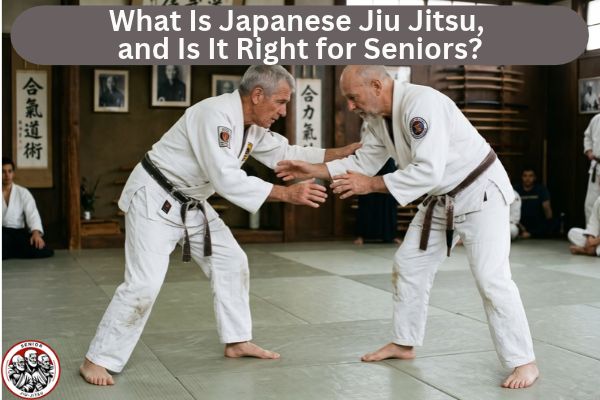
Japanese jiu jitsu is a traditional martial art built on throws, joint locks, pins and controlled falls, where technique and timing matter more than strength. Seniors can start it, provided the class is beginner-friendly, the instructor knows your health history, and you train at a pace your body allows.
This guide covers what Japanese jiu jitsu is and answers the questions older beginners and their families ask most: how safe it is, how you learn to fall, how hard it is, which techniques you will meet, and how to find a class.
What is Japanese jiu jitsu?
Japanese jiu jitsu is a martial art that grew out of the unarmed fighting methods of old Japan, and it teaches you to defend yourself by redirecting an attacker’s force instead of meeting it with your own. You will also see it spelled jujutsu or ju-jitsu. The name is usually translated as “the gentle art” or “the art of yielding.”
The practical idea is simple. If someone pushes, pulls, grabs or swings at you, you move out of the way, unbalance them, and finish with a throw, a hold or a joint lock. A smaller or older person can use this because the technique relies on leverage and balance, not muscle.
Judo was developed from older jujutsu schools by Jigoro Kano in the late 1800s. Brazilian jiu jitsu later grew from Japanese roots and now concentrates mostly on ground grappling. Japanese jiu jitsu sits between them and varies by school. Some teach mainly throws and holds, some add strikes, and some include defence against weapons.
|
Japanese jiu jitsu |
Judo |
Brazilian jiu jitsu |
|
|---|---|---|---|
|
Main focus |
Self-defence with throws, locks, holds and sometimes strikes |
Throwing and pinning, usually as a sport |
Grappling on the ground |
|
Standing work |
Central |
Central |
Present, but often less emphasised |
|
Joint locks |
Wrists, elbows, shoulders and others |
Mostly elbow locks |
Many locks, mostly on the ground |
|
Typical class |
Drilled techniques with a partner |
Drills and throwing practice |
Drills and rolling |
Because the label covers many styles, two schools that both say “Japanese jiu jitsu” can feel quite different. Ask any school what a typical beginner class looks like before you commit.
Is jiu jitsu safe for seniors?
Jiu jitsu can be safe for seniors when the class is taught at a beginner level, training partners are controlled, and you tell the instructor about any health conditions before you start. It is a contact activity, so it carries real risks, and the choice of school matters more than any other factor.
The areas that need the most care at an older age are the knees, shoulders, neck, lower back and wrists. Falls, awkward twists and partners who move too fast cause most problems. A good instructor reduces all of these by slowing the pace, using cooperative drills and keeping beginners away from hard sparring.
Talk to your doctor before your first class, especially if you have any of the following:
- A heart or blood pressure condition
- Osteoporosis or a history of fractures
- A joint replacement
- Balance problems or dizziness
- Medication that affects bruising or bleeding
Tell the instructor about these things as well. They can adjust what you do, and they can only do that if they know.
Two habits do most of the safety work in class. The first is tapping: if a hold or lock hurts, you tap your partner or the mat and they release at once. Every beginner learns this on day one, and using it early is a sign of good judgement. The second is a proper warm-up, because cold joints and stiff muscles are easier to strain. The warm-up stretches for Japanese jiu jitsu article covers what to do before class.
How do you fall safely in jiu jitsu?
You fall safely in jiu jitsu by learning ukemi, a set of breakfall techniques that spread the impact over a larger part of your body and keep your head off the mat. Falling is one of the first skills taught, and it is the reason a throw does not have to injure the person receiving it.
The main principles are the same across styles:
- Tuck your chin toward your chest so your head does not strike the floor.
- Slap the mat with your arm, held at an angle away from your body, at the moment you land. This spreads the force along the arm and the side of the body.
- Keep your arms from reaching out to catch yourself. A stiff arm used as a brace puts the force into the wrist, elbow and shoulder.
- Breathe out as you land, which keeps the body from locking up.
- Stay relaxed. A loose body absorbs a fall better than a rigid one.
Older beginners should expect a gradual progression, and a good school will not hurry it:
- Practise the slap and the chin tuck while lying on the mat.
- Rock backward from a seated position into a back fall.
- Fall to the side from a kneeling position.
- Fall from a squat, then from a low standing position.
- Add a partner’s gentle throw only when the earlier steps feel automatic.
Some schools teach rolling falls as well. If rolling bothers your neck, shoulders or back, say so. Many instructors will substitute a different fall or drop the roll entirely for students who cannot do it comfortably.
Practised regularly, falling is also useful outside the dojo, because the habit of tucking the chin and staying loose carries over to slips on ice or wet floors. That is a possible benefit, not a promise, and nobody should treat training as protection against every fall.
Is Japanese jiu jitsu hard to learn, and what age is too late to start?
Japanese jiu jitsu is hard at first in the way any new physical skill is hard, but beginners learn it in small pieces, and there is no fixed age at which it becomes too late to start. What matters more than your birth year is your current health, your doctor’s opinion and whether the class suits you.
The difficulty for a beginner is mostly about coordination and memory. You are learning unfamiliar movements, remembering their order, and doing them with a partner who is also learning. Expect to feel clumsy for the first weeks. This happens to students of every age, and it passes with repetition.
Seniors have some advantages. Many are patient, willing to ask questions, and happy to repeat one movement until it is right, which is how technique is built. They are also less likely to treat class as a contest, and that lowers the injury risk for everyone.
A few adjustments help older beginners:
- Choose a class with a slow, structured beginner program.
- Train with partners who are controlled and of a similar size when possible.
- Rest between rounds and take a break whenever you need one.
- Take extra recovery days between sessions at first.
- Skip any movement that causes sharp pain, and tell the instructor why.
The early weeks have common stumbling blocks, such as trying to use strength, forgetting to tap or training through pain. The common mistakes to avoid in white belt training for seniors article goes through them in detail.
What are the core Japanese jiu jitsu techniques, including joint locks?
The core techniques of Japanese jiu jitsu are throws, holds and pins, joint locks, escapes from grabs and, in many schools, strikes and chokes. A beginner class usually starts with falling, stance and movement, then adds simple versions of these techniques one at a time.
- Throws (nage waza): You unbalance a partner and send them to the ground, using hips, legs and timing instead of lifting. Beginners practise slow, low throws on a mat. A separate piece on low impact takedowns for older jiu jitsu students explains how to keep standing work gentle on the knees.
- Holds and pins: Once someone is on the ground, you control them with body position and weight so they cannot get up or strike.
- Joint locks (kansetsu waza): You bend or twist a joint, such as the wrist, elbow or shoulder, toward the edge of its normal range so the other person has to stop or move.
- Escapes: You free yourself from wrist grabs, lapel grabs, bear hugs and holds on the ground.
- Strikes (atemi): Some schools teach punches, kicks and palm strikes mostly as a way to create an opening for another technique.
- Chokes: Some schools teach them, and some leave them out of beginner classes.
Joint locks make many newcomers nervous, so it helps to know how they are practised. In class, the person applying the lock moves slowly and stops the moment the partner taps or says stop. The goal is to learn the angle and the control, not to cause damage. A well-run class treats the partner’s joints as something to protect.
One example is the Americana, a shoulder lock that is common across grappling arts. The Americana arm lock guide breaks it down step by step.
Not every school teaches all of these, and the balance differs. If you want a particular emphasis, such as throws without much ground work, ask what the curriculum covers.
How do seniors start jiu jitsu, and how do you find a class near you?
Seniors start jiu jitsu by getting a doctor’s approval, finding a school with a beginner program for adults, and taking a trial class before committing. The whole process can take a week or two and costs you nothing but a few phone calls.
Follow these steps in order:
- Talk to your doctor. Describe the activity and mention any joint, heart, balance or bone concerns.
- Search for schools nearby. Try “Japanese jiu jitsu,” “jujutsu” and “ju-jitsu” along with your town, and add “adult beginners” or “seniors.” Community centres and martial arts directories can also list local schools.
- Contact the schools. Ask whether they have older students, whether there is a beginner class, and how they handle injuries and health conditions.
- Watch a class. Many schools let you sit and observe. Notice how the instructor corrects students and how partners treat each other.
- Take a trial class. Tell the instructor your age and any limitations before you step on the mat.
- Ask about fees and terms. Find out what is included and whether a contract is required before you sign anything.
When you observe or try a class, these are good signs:
- The instructor explains movements clearly and corrects gently.
- Beginners practise separately or at a slower speed.
- Students tap early and partners release immediately.
- Older students are part of the class and are not treated as a problem.
- The atmosphere is calm and the mat area is clean and uncluttered.
If a school pushes you to spar hard in your first week, or dismisses your concerns about an injury, try another one. Family members helping with the decision can do all the same checks, including visiting a class with the senior and asking the instructor questions.
Frequently asked questions: five questions seniors ask before their first class
Do I need to be flexible or fit before I start?
No, you do not need to be flexible or fit before starting, because beginner classes are designed to build both gradually. Some basic mobility helps, such as being able to get down to the floor and up again, but your instructor can modify movements around what your body can do now. Stretching routines can improve range of motion over time, and the top 10 stretches for Japanese jiu jitsu practitioners article is a place to start.
What should I wear to a first class?
Wear loose, comfortable clothing without zips, buckles or hard pieces unless the school tells you otherwise. Many Japanese jiu jitsu schools use a uniform called a gi, and some lend one for trial classes or sell them at the school. Ask before you go, since requirements differ, and remove jewellery and watches for safety.
Will I have to spar with younger, stronger people?
Not necessarily, because most beginner classes work through drills with a cooperative partner and do not start with free sparring. If a school does include sparring, you can ask to pair with a controlled partner or sit it out. A trustworthy instructor will respect that request.
How often should a senior train?
Many beginners start with one or two classes a week, then add more only if they recover well. Older bodies often need more rest between sessions, and soreness that lasts several days is a signal to scale back. Your doctor and instructor can help you decide on a schedule that fits your health.
Does Japanese jiu jitsu work for self-defence at an older age?
It teaches principles that can help, such as balance, distance, escapes and leverage, and these do not depend on youth or size. No martial art guarantees the outcome of a real confrontation, though, and awareness and avoiding danger remain the most reliable protection. Treat training as a way to build skill and confidence, not as a promise of safety.
So is Japanese jiu jitsu a good fit for you?
From my own experience, I found I was sore and stiff after classes at the beginning. Getting thrown onto your hip even on a mat can hurt, and it takes a bit of time to get used to. The break fall does help, but your body has to get used to being thrown. My advice: get plenty of rest and sleep, take extra time between classes if still sore, do additional stretching and isometric exercises on joints that give you the most trouble. Overall, though in a relatively short time you will find you are more flexible, strong and capable of training than you thought possible.
Japanese jiu-jitsu is a good fit for you if your doctor agrees, you can find a school with a patient beginner program, and you are willing to start slowly. It rewards technique and consistency, which are things people of any age can build.
It may be a poor fit right now if you have a medical condition your doctor advises against, if the only nearby schools emphasise hard sparring, or if you are unwilling to tap out when something hurts. In those cases, ask your doctor about gentler options or look for a different school before ruling the art out.
If you are still unsure, the lowest-risk next step is to call one local school, ask the questions from this guide, and watch a class. That visit tells you more about whether the training suits you than any article can.