
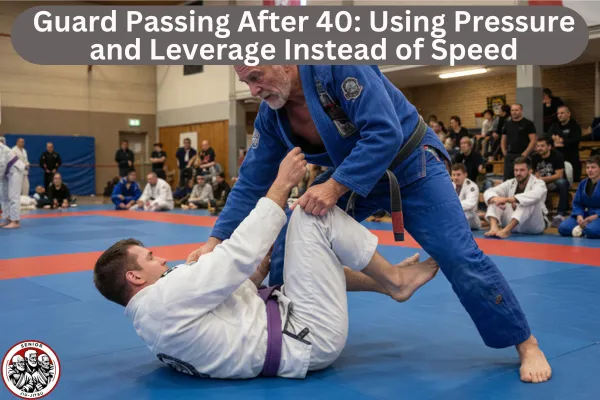
Most guard passing instruction is built around a fast, flexible body. Torreando, leg drags into scrambles and diving around the knees all work well when you can recover from a mistake in half a second. After 40, recovery takes longer, and a failed explosive pass often ends with a sweep, a triangle or a sore back.
Guard passing for older jiu jitsu practitioners works better when it is built on the things that do not fade with age: heavy hips, patient posture, good angles and a clear order of operations. This article gives you three passing approaches that share those ingredients, then covers joint care and a drill plan. It starts at the moment you land in someone’s guard and ends when you settle in side control.
Why speed-based passing fails the older body (and what to use instead)
A speed pass depends on beating your opponent’s reaction time. If you are a step slower, the guard player has time to frame, pummel their legs back in and re-guard. You respond by rushing, your posture collapses, and now they are attacking you.
Older practitioners usually have an advantage that goes unused: patience. A pass built on pressure does not need to beat anyone’s reaction. It limits what the guard player can do, then removes the legs one at a time. The weight sits on their hips and ribs, so their movement becomes tiring for them, not for you.
The system in this article has three parts:
- Pressure pass: flatten the guard with your hips and shoulders, then slide through.
- Leverage pass: open a closed guard with posture and angle, then stack or step through.
- Leg control pass: pin the legs in open guard and walk around them.
All three follow the same pattern: posture first, control the hips and legs, move your body to an angle, then finish by pinning the upper body. Learn that pattern and the individual techniques become variations of it.
Posture and base: the position you pass from before you pass anything
Every pass starts with your position in the guard, and most failed passes are lost before the first movement. Two points matter most.
Your spine stays long and upright. In closed guard, if your head is pulled below your hips, you are in the zone where chokes, triangles and armbars live. Keep your chest up, your head over your hips, and your elbows tight to your ribs. When the guard player grabs your collar or sleeve and pulls, resist with your back and hips, not your arms.
Your base is wide and low in the hips. On your knees, set them roughly shoulder width apart or a bit wider, with your hips sitting back over your heels rather than leaning forward over your hands. A wide base makes it hard to be tipped sideways. Putting your hands on the mat between their legs is a common habit for beginners and invites a guillotine or a pulled-in arm.
A few hand positions to start with:
- Both hands on the hips or belt line, thumbs out, elbows in.
- One hand on a hip, the other on the biceps or sleeve to keep them from grabbing your collar.
- Knuckles on the upper thighs when they open their legs, to stop the knees from coming through.
Practise just holding this posture in someone’s closed guard for a minute while they try to break it. If you can stay upright and calm there, the passes become much easier to learn.
Pressure passing: using your hips and shoulders to flatten the guard
Pressure passing means putting your body weight where the guard player needs space. The guard works by creating distance: frames with the arms, hips that move away, legs that insert. Pressure removes that distance.
A basic version for open or half guard looks like this:
- From a kneeling or low standing position, drive your shoulder into their chest or the side of their ribs, with your head on the side you want to pass toward.
- Underhook or overhook their far arm so they cannot turn into you easily. An over-under grip, with one arm over the far arm and one under the near arm, is a good first choice.
- Settle your hips low and heavy, with your chest pressing across their torso. Your weight is on them, not on your own hands and knees.
- Slide your knee, or your whole leg, across their thigh and work toward the hip line.
- Once the legs are past, bring your hips down and settle in side control.
The key trait is slowness. You are not trying to get through in one movement. You move a few inches, wait for them to adjust, then move a few more. Each time they push, you can use their pushing to go lower or deeper.
One detail that makes it work: keep your head close to their head or on the far side of their shoulder, with your ear near their ear. A head hanging out in front of their chest is an easy target for a guillotine and gives them space to frame against your neck.
Leverage passing: stacking and angling to open a closed guard safely
Closed guard is the position that scares newer students most, because the legs wrap around your waist and your own hips are trapped. The way out is to change angle and use leverage from your posture, not to yank the knees apart with your arms.
A simple, low-risk opening sequence:
- Establish posture with both hands on their hips or belt.
- Place one elbow inside their thigh, near the hip crease, and keep your other hand controlling the opposite hip or sleeve.
- Raise one knee, with your foot flat on the mat, to build a stable platform.
- Drive your hips forward and slightly toward that raised knee while pressing the elbow into the thigh. The ankles lose their hold as your hips move.
- As the legs open, shift your weight forward onto their hips so they cannot close the guard again.
From there you can stack. Stacking means pushing their legs and hips up toward their head, so their hips come off the mat and the guard player is folded. In that position they have little ability to move or attack, and you can walk around the legs to a pass.
Stacking has two limits. Do not drive straight down on their neck with your full weight. Apply pressure gradually, and release if your partner taps or signals discomfort. Also keep your own head up and your back straight. If you tuck your chin and stare at the mat, the stack becomes a problem for your own neck and back as much as theirs.
Controlling the legs: a low-effort approach to open guard
Once the guard is open, the legs are the weapons: hooks, knee shields, butterfly hooks and feet on your hips. Chasing the legs with your hands usually fails, because your hands are slower than their feet. Pin them with your body instead.
A knee pin pass is a good third approach:
- Stay in a wide, low base and keep your hands on their knees or thighs, not reaching around.
- Press both of their knees together and toward one side with your hands and forearms. When the knees are stacked, the hips lose most of their mobility.
- Step your outside foot to that side and keep your weight on their legs, with your chest over their thighs.
- Slide your knee through the gap behind their top knee, or walk your hips around to the waist line.
- Replace the hand control with an underhook on the far side as you settle, and finish in side control.
The effort stays low because their own legs are held down by their own bodyweight. You use your weight to hold the legs together, which takes far less energy than chasing them. If they re-insert a leg, go back to posture and rebuild the pin, rather than scrambling to recover.
Passing without wrecking your knees, neck and lower back
Passing puts load on three areas that older practitioners need to protect.
Knees. Avoid long periods on one knee with the foot trapped. Keep both feet free where you can, and avoid twisting on a planted knee. When kneeling, pad with the mat’s soft area or choose a position that spreads your weight across the shin rather than the kneecap. Stop and reset if you feel sharp or pinching pain. If you are coming back from a knee problem, read returning to training after an injury before adding heavy pressure passing.
Neck. Do not let your head hang forward and down in the guard. Keep your chin slightly tucked but your eyes forward. When you stack, remove weight quickly if it feels uncomfortable for either person.
Lower back. Hinge from the hips, not from the spine. If you find your back rounding every time you bend over a partner, you are probably leaning on your arms; bring your hips in closer and let your legs hold your weight.
A short warm-up helps with all three. Hip circles, cat-cow, gentle neck rolls and a few bodyweight lunges before class are enough for many people.
A simple drill plan for two or three sessions a week
The plan below suggests one focus per session. Adjust it to what your gym already teaches.
Session 1: posture and pressure
- 5 minutes: hold posture in closed guard against a partner trying to pull you down, then swap.
- 10 minutes: drill the pressure pass from open or half guard, with your partner giving light resistance.
- 5 minutes: start in guard and aim only to reach a chest-to-chest, shoulder-pressure position.
Session 2: leverage and stacking
- 5 minutes: practise the elbow-in-thigh opening from closed guard with a cooperative partner.
- 10 minutes: add the stack and walk-around, slowly.
- 5 minutes: positional rounds starting in closed guard, where you only need to open the legs.
Session 3 (if you train a third time): leg control
- 10 minutes: drill the knee pin pass against a partner who offers about half resistance.
- 10 minutes: positional sparring from open guard, with the goal of settling in side control.
Across all three sessions, work toward one rule: pass only when you are in good posture. If you notice your head dropping, stop, reset and start again. Over a few weeks, that habit will do more for your guard passing than any additional technique.
Where passing fits next to your standing game and the rest of your training
Guard passing begins after the standing game ends. If you land on top of someone through a controlled takedown, you can go straight into the posture and pressure ideas above. The article on low impact takedowns for older jiu jitsu students covers that earlier stage, and the two work well together: a takedown that puts you in a heavy top position is the best entry to a pressure pass.
Passing also pairs well with positional control. After you settle in side control, your next task is holding the position and finishing from it, so the pass is one link in a longer chain. Many students find it useful to spend a few weeks on passing alone and then start joining it to the position that follows.
Keep your expectations realistic. The first goal is to pass with control against a partner of similar size who is cooperating, then against more resistance. Progress at your own speed, and use rounds against newer partners to test the system before you rely on it against someone more experienced. The aim is a small set of passes that you can perform calmly every time, whatever your age or athletic background.